

This site is built for Scrabble players who want fast, reliable answers while they practice or prepare for games. It focuses on two everyday needs: checking whether a word is valid in official lists and finding playable words from a rack of letters. Both tasks are handled by a simple, direct interface so players can stay focused on the game rather than wrestling with a complex tool.
Scrabble study often comes down to confidence. When you are mid-game or drilling at home, you want a clear yes or no on whether a word is allowed, without guesswork or conflicting sources. That is the core promise here: validation against official lists, delivered quickly and consistently. The system does not infer validity from definitions or from crowdsourced content. It reports whether a word exists in the official lists and then provides helpful context around it.
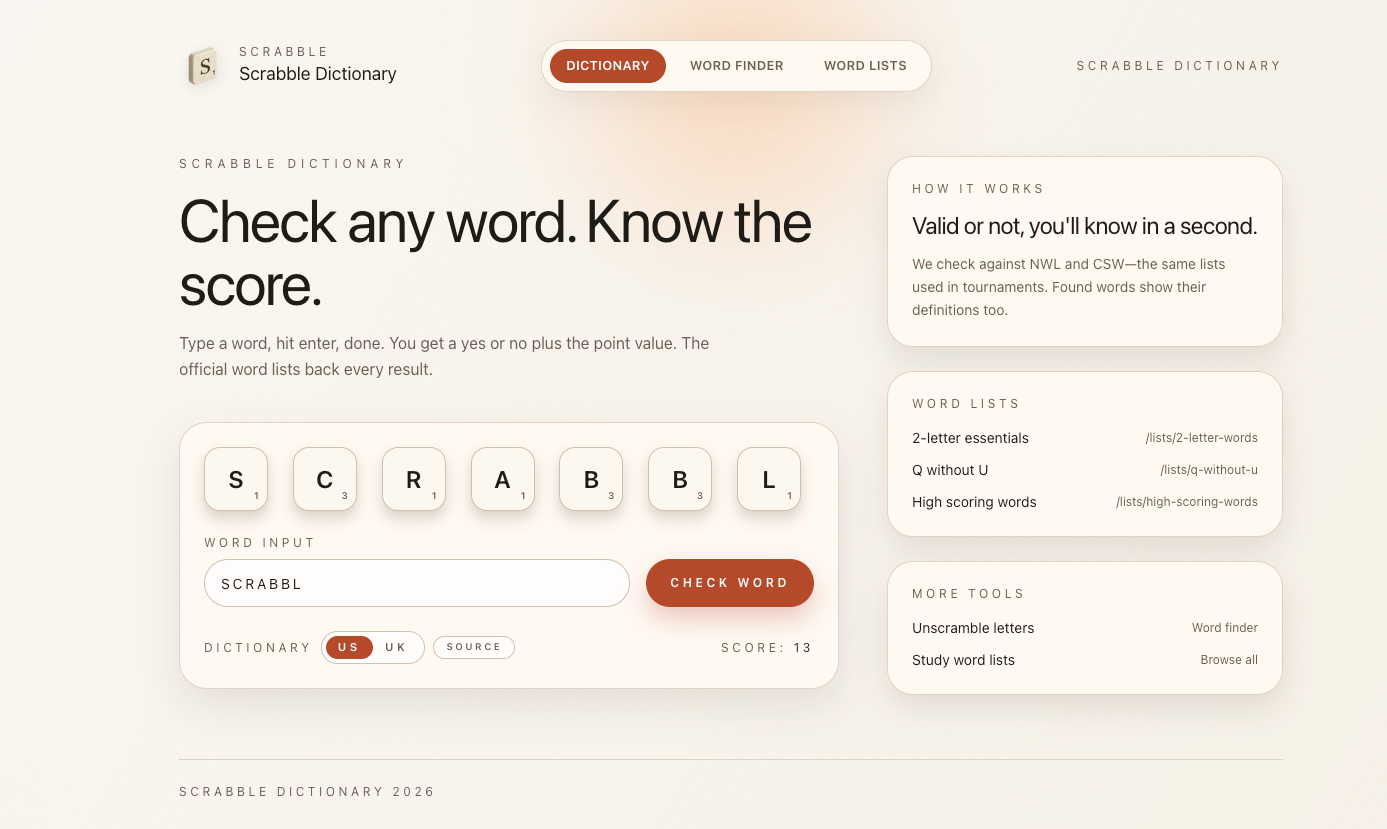
The dictionary side is designed for certainty and speed. You submit a word, and the result confirms its status in the official lists. This is useful during study sessions when you are reviewing small word sets, checking unfamiliar hooks, or validating words that look plausible but might be phony. The output is concise so you can move on quickly, and the experience avoids noise or overly elaborate explanations.
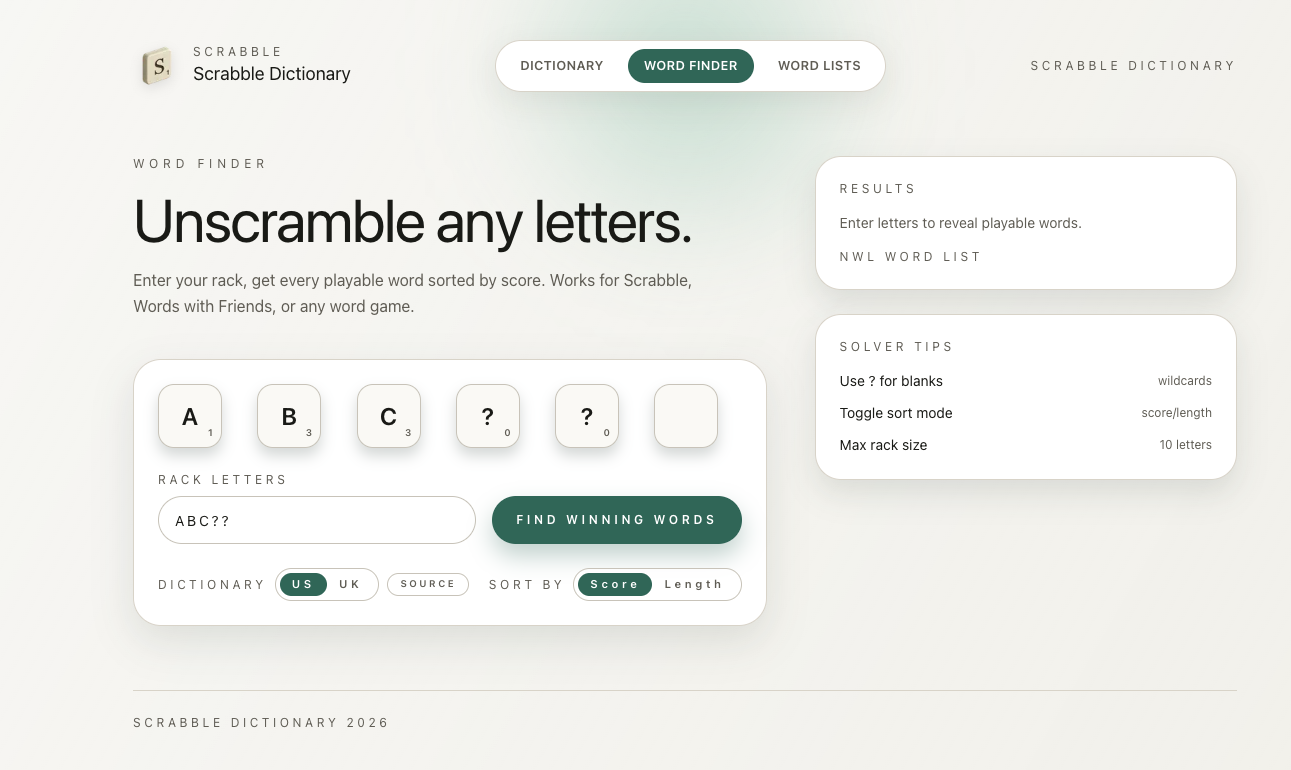
The word finder is built for practical play. You can input your rack and include blanks using the "?" character. The solver returns valid words you can play, factoring in blank tiles as wildcards. This helps with anagram practice, rack management drills, and exploration of high-probability plays. The emphasis is on quick, usable results that match official lists, not on flashy visuals or nonessential data.
Definitions are added to make the results more meaningful, but they are not treated as the source of truth for validity. Many Scrabble-valid words are obscure, short, or domain-specific, so having a definition can make them easier to remember. A separate lookup runs after validation and is cached so repeat lookups are fast. If a word is valid but the definition is missing, the word still appears as valid, and the interface can simply omit the definition. This keeps the core validation logic strict and avoids confusing a missing definition with an invalid word.
The project also includes word list pages for study and search entry points. These pages help users browse list-based content, revisit tricky words, and build familiarity with the official vocabulary. They are intentionally simple so the primary focus stays on the words themselves. The goal is to support short, frequent study sessions rather than long, distracting reading experiences.
A typical session is straightforward. You type a single word to confirm its status, or you enter a rack to explore possible plays. Results are returned as a clean list that is easy to scan, so you can compare options without extra friction. The experience is built for quick checks during study sessions and for deeper exploration when you have time to learn new patterns.
The background for this project comes from common pain points in Scrabble practice. Many tools mix unofficial sources, hide their validation rules, or overload the user with unrelated features. That makes it harder to trust the result and slows down study. This site is intentionally narrow in scope. It does not try to be a full analytics suite or a move search engine. Its purpose is to be a reliable dictionary and word finder that respects official lists and stays fast and predictable.
Because the focus is on official lists, the content is treated as authoritative and consistent across the site. You can use it to double-check a single word, build a list of valid plays from a rack, or review official word list pages over time. The consistent validation rules make it easier to build intuition, which is essential for Scrabble improvement.
It also supports different levels of play without changing its core behavior. New players can confirm common words and learn short, high-value entries. Intermediate players can explore racks, practice vowel and consonant balance, and get used to blanks. Advanced players can quickly verify suspicious words, study list pages for rare entries, and build confidence in tournament-valid vocabulary. The same clear workflow works for all of them because the rules stay the same.
The intent is to remove friction from practice. You should be able to get an answer in seconds, then return to studying or playing with confidence.
In short, this project exists to serve players who care about accurate validation, practical word finding, and efficient study. It provides a clear and focused workflow: check validity, explore playable words, and learn definitions when they help retention. The result is a tool that is simple, reliable, and designed for real Scrabble practice rather than for novelty or overreach.
Scrabble study often comes down to confidence. When you are mid-game or drilling at home, you want a clear yes or no on whether a word is allowed, without guesswork or conflicting sources. That is the core promise here: validation against official lists, delivered quickly and consistently. The system does not infer validity from definitions or from crowdsourced content. It reports whether a word exists in the official lists and then provides helpful context around it.
The dictionary side is designed for certainty and speed. You submit a word, and the result confirms its status in the official lists. This is useful during study sessions when you are reviewing small word sets, checking unfamiliar hooks, or validating words that look plausible but might be phony. The output is concise so you can move on quickly, and the experience avoids noise or overly elaborate explanations.
The word finder is built for practical play. You can input your rack and include blanks using the "?" character. The solver returns valid words you can play, factoring in blank tiles as wildcards. This helps with anagram practice, rack management drills, and exploration of high-probability plays. The emphasis is on quick, usable results that match official lists, not on flashy visuals or nonessential data.
Definitions are added to make the results more meaningful, but they are not treated as the source of truth for validity. Many Scrabble-valid words are obscure, short, or domain-specific, so having a definition can make them easier to remember. A separate lookup runs after validation and is cached so repeat lookups are fast. If a word is valid but the definition is missing, the word still appears as valid, and the interface can simply omit the definition. This keeps the core validation logic strict and avoids confusing a missing definition with an invalid word.
The project also includes word list pages for study and search entry points. These pages help users browse list-based content, revisit tricky words, and build familiarity with the official vocabulary. They are intentionally simple so the primary focus stays on the words themselves. The goal is to support short, frequent study sessions rather than long, distracting reading experiences.
A typical session is straightforward. You type a single word to confirm its status, or you enter a rack to explore possible plays. Results are returned as a clean list that is easy to scan, so you can compare options without extra friction. The experience is built for quick checks during study sessions and for deeper exploration when you have time to learn new patterns.
The background for this project comes from common pain points in Scrabble practice. Many tools mix unofficial sources, hide their validation rules, or overload the user with unrelated features. That makes it harder to trust the result and slows down study. This site is intentionally narrow in scope. It does not try to be a full analytics suite or a move search engine. Its purpose is to be a reliable dictionary and word finder that respects official lists and stays fast and predictable.
Because the focus is on official lists, the content is treated as authoritative and consistent across the site. You can use it to double-check a single word, build a list of valid plays from a rack, or review official word list pages over time. The consistent validation rules make it easier to build intuition, which is essential for Scrabble improvement.
It also supports different levels of play without changing its core behavior. New players can confirm common words and learn short, high-value entries. Intermediate players can explore racks, practice vowel and consonant balance, and get used to blanks. Advanced players can quickly verify suspicious words, study list pages for rare entries, and build confidence in tournament-valid vocabulary. The same clear workflow works for all of them because the rules stay the same.
The intent is to remove friction from practice. You should be able to get an answer in seconds, then return to studying or playing with confidence.
In short, this project exists to serve players who care about accurate validation, practical word finding, and efficient study. It provides a clear and focused workflow: check validity, explore playable words, and learn definitions when they help retention. The result is a tool that is simple, reliable, and designed for real Scrabble practice rather than for novelty or overreach.